You find yourself in the kitchen, cupboard open, and you’ve finished the cookies.
You don’t even remember eating the cookies, really.
You just kept getting up from the couch, going in the kitchen, and having just one more…
If you’ve ever been in that situation, tired after a long day, snacking when you know you’re not really hungry, this is for you.
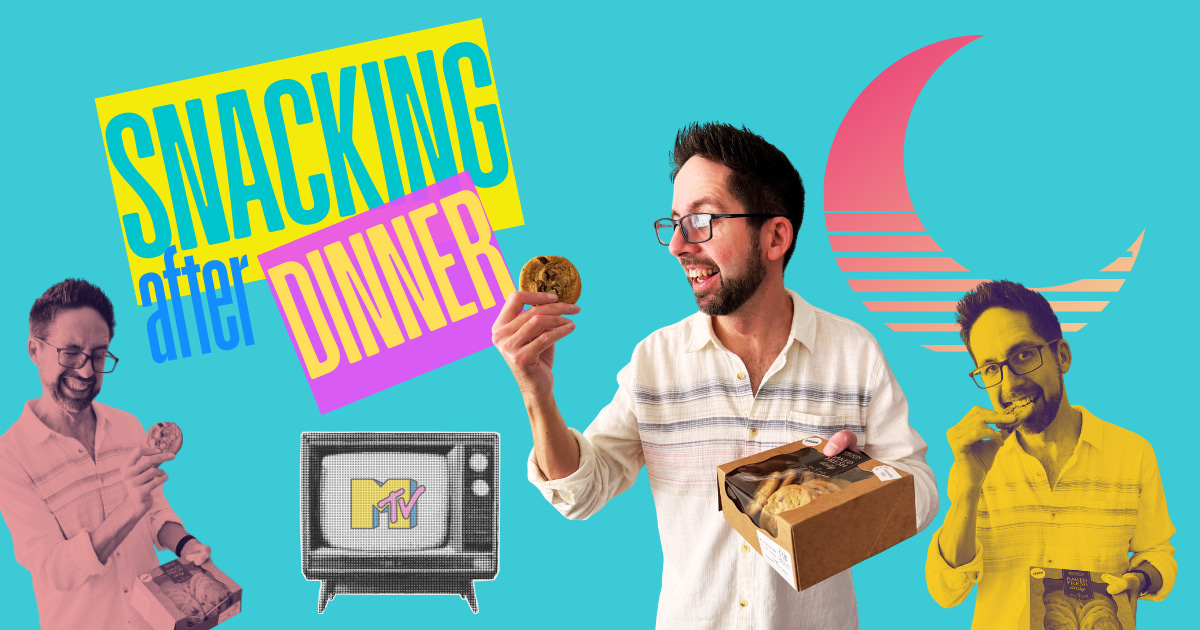
Made my a human. This image was brought to you by an iPhone 16 Pro,
ten glorious minutes on Canva, and two chocolate chip cookies from Sprouts.
Why Do We Snack at Night?
Just knowing why you snack will give you a lot more self-compassion around snacking at night, and self-compassion is correlated with healthier eating (Sirois et al., 2015):
Lets take a bio–psycho–social look at why we snack.
Bio
From a biological standpoint, combinations of carbohydrates, fats, and salt are hyperpalatable (Fazziino et al., 2019; Thanarajah et al., 2023). Hyperpalatable is just a fancy word for “delicious.”
Couple that with the fact that most people have more cravings they’re tired, and after dinner is going to be a time when many people have an urge to snack (Yang et al., 2023).
These three combinations reliably make food hyper-palatable:
(1) fat and salt
(2) fat and simple carbohydrates (sugar)
(3) carbohydrates and salt
Social
The social aspect is that snacking at night may be “learned.” Learning, from a behavioral perspective, just means you did something and it “worked,” so you did more of it. It isn’t like someone told you to do it.
It might be something other members of your family would snack after dinner growing up. It might be something members of your household do now. When we see other people get up to snack, it’s normal for us to want to also (Cruwys et al., 2015; Herman, 2015; Elliston et al., 2017; Bevelander et al., 2017).
Psycho
The psychological aspect is the things you learned on your own. Like, if you tried snacking one time when tired, and it perked you up. Or if you were stressed out and snacking calmed you down (O’Connor & Conner, 2017). Interestingly, your lifetime accumulation of stress situations predicts how much food chills you out when stressed (Klatzkin et al., 2024).
Or it could be that you tried it and just enjoyed it (Thanarajah et al., 2023). Again, from a bio-psycho perspective, we’ve learned to like snacks because they’re delicious. We might have our own history with wanting to enjoy something at the end of the day.
Then, it has to do with your current situation — maybe you’re in a stressful period at work or at home, and it triggers that stress—>snacking habit (Elliston et al., 2017).
That maps on to how we cope with stress, whether distressing thoughts, difficult emotions, or uncomfortable body states. We might have learned to suppress our stress or push it down or ignore it, and food just became another way to do that.
Things get a little blurry, because we also have psycho-social learning. It might be social learning like other people snacking when stressed out or snacking when tired, and you saw them do that. Or it might be other people eating after dinner for enjoyment or bonding, and you learned from that.
It’s Important to Know That it Makes Sense to Mindlessly Snack at Night
You aren’t broken. There’s nothing wrong with you. You aren’t addicted to chips/cookies/muffins/candy-bars/whatever (probably).
It’s just that snacks are made to be delicious, we’ve seen other people eat at night for a variety of reasons that make sense, and we have our own personal history with snacks and different internal states (tiredness, stress, emotions, etc).
All of the reasons, whether bio, psycho, social, or all three together, make sense. It absolutely makes sense to snack.
But, I’m guessing you’re reading this because it doesn’t fit your personal values (or your goals) to snack every time you’re tired or stressed out. Many of us just have way too many things in our lives to avoid stress or tiredness.
Here’s How to Fix It
We’re going to look at it from a contextual behavioral science framework. Two of my favorite researchers, Evan Forman and Megan Butryn, in their manual Effective Weight Loss, simplified it to:
Control what you can, accept what you can’t.
Here’s what you can control:
You can control actions.
That’s it.
You can control the choices you make and things you do.
Here’s what you can’t control:
You can’t control your cravings, your emotions, your automatic thoughts.123 Those come and go whether you want them there or not.
If you have decades of thinking, “Cookies sound pretty good right now,” every night at 8 PM, then that thought is not going anywhere any time soon.
You have marginal control over things like your tiredness and stress level. No matter how perfectly set up your life, you might have a more stressful day than you want. No matter how perfect your sleep routine, you might not sleep well.
Ironically, when you recognize what you can’t control, you get all of your power back.
Willingness to Feel is the Way Out
- If you are totally unwilling to feel an emotion, then you have to eat to numb that emotion out. Conversely, if you are willing to feel that emotion, you don’t have to eat.
- If you are totally unwilling to be with certain thoughts, then you have to eat to distract yourself from those thoughts. Conversely, if you are willing to feel that emotion, you don’t have to eat.
- If you are totally unwilling to feel tired, then you have to eat to perk yourself back up. Conversely, if you are willing to feel tired, you don’t have to eat.
- If you are totally unwilling to feel a food craving, then you have to make that craving go away. Conversely, if you are willing to feel tired, you don’t have to eat.
The irony is that you don’t even need to be willing to feel things for very long. If you can be willing to feel things for even just a few minutes, that creates a space for you to be able to make a more mindful choice.
Mindful Choices: Who Do You Want to Be About Eating Right now?
Note, I didn’t ask what would fix you right now.We aren’t trying to make the feelings or thoughts or bodily sensations or cravings go away.
Instead, we’re trying to look at the kind of person you want to be.
For example, myself:
- I want to be the kind of person who eats chocolate chip cookies when I’m in a chill moment, when I can eat them slowly and enjoy them, and when I’m not distracted.
- I want to be the kind of person who doesn’t eat chocolate chip cookies when I’m stressed out, bored, or tired. I don’t want to eat them quickly, mindlessly, or when distracted.
If you look at the above examples of when I do and do not want to eat chocolate chip cookies, it’s really clear. I could actually turn that into a checklist, if I wanted:
❌ feeling stressed
❌ feeling bored
❌ feeling tired
❌ with screens
❌ eating quickly
❌ eating mindlessly
✅ chill
✅ present
✅ eating slowly
✅ enjoying how they look, taste, and crunch
That makes it obvious when it fits my values to eat cookies and when it does not.
A keen observer might notice that, ironically, that tired, stressed, or bored are when most people have cravings. Interestingly, for me, cravings are often a signal of when it doesn’t fit the kind of person I want to be to eat cookies.
Of course, you need to figure out who you want to be about eating. Then you can develop your own checklist. But, sometimes that’s easier to understand when you look at an example, first.
Your After Dinner Eating Plan
So, now you have three important things:
- You know why it’s common to want to eat after dinner
- You know willingness to feel is the way out
- You know how to decide when to eat the thing and when not to
You can use all of these three things tonight.
When you have that craving to snack after dinner, the first thing to do is to take a step back and look at why you have that craving. Recognize how normal it is to have that craving right then. Notice how most humans would probably have a craving to eat right then.
Next, look at what’s going on inside: How do you feel in your body? Are you tired? Tight? Hot? Cold? Pain? Could you be willing to feel that for a few minutes, without having to fix it? Are there any emotions or stress? Can you name the emotion? Or can you identify the stress? Would you be willing to just let that be in your orbit for a few minutes, without doing anything about it? And the cravings you’re having, could you just sit with those for a few minutes, without acting on them?
Finally, in that space where you’re willing to sit with everything going on inside, that’s where you can look at the kind of person you want to be. Maybe even pull out your checklist. Try out making a decision based on your checklist, instead of your cravings.
This is a Skill That Requires Practice
Sometimes when I post reels about this on Instagram, I’ll get comments that “sitting with cravings is impossible.” Or like this thread:
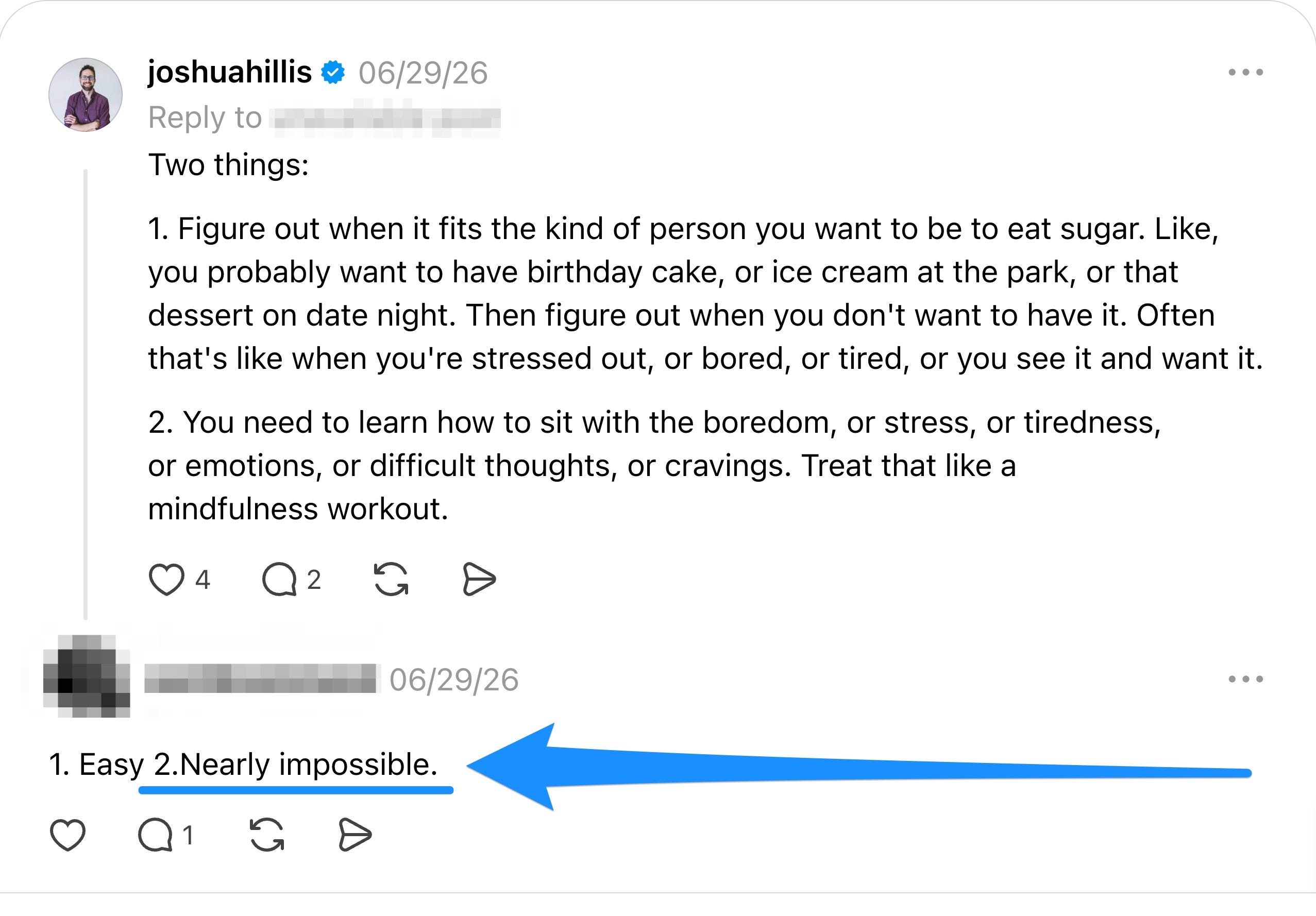
This is something people typically practice for at least a few months, if not a year. Clients I’ve had that worked with me for over a year have became masterful at this at a level most people can’t even imagine.
I work with my clients on this in stages, and of course much more in depth. We practice it together and they practice it on their own, at least once per day.
My point is — this isn’t something you read about once and then automatically have nailed. It’s something you practice daily, for months.
If your heart sank a little reading the “for months” part, I hope to flip it around a little for you. Most people in the fitness world act like being with cravings and making a choice based on your values is impossible. It’s actually not impossible, I teach four dozen every year to do it. It is difficult. It does take time, but it’s very possible.
Which reminds me of a quote from an action movie:
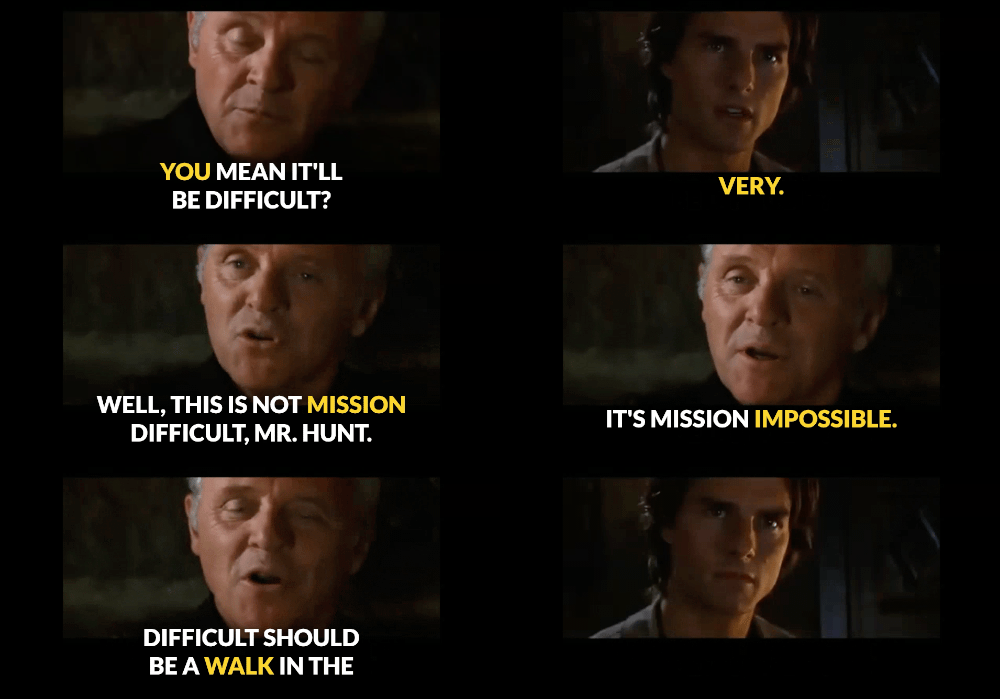
Mission Commander: So you think it will be difficult?
Ethan Hunt: Very.
Mission Commander: Well Mr Hunt, this is Mission Impossible, not mission difficult. Difficult should be a walk in the park for you.
Mission Impossible 2
I love Mission Impossible 3, 4, and 5.
1 and 2 are a little different, and they totally fell off on 6 and 7… but I digress.
The quote might seem a little silly, but I think it applies. Watching Mission Impossible, it seems like everything the team does is impossible. Within that fictional world, though, they’re+ just doing what they’ve been trained to do.
If you’ve never seen someone get trained to sit with their emotions and cravings, you’ve never seen that training montage, it can be hard to believe that it exists. It might seem even more impossible than what happens in action movies. But it’s not. It’s just training.
My mission in life is to help people find out that they aren’t broken, there’s nothing wrong with them, that they just haven’t been trained in the skills they need to hit their eating goals.
— Josh
Who is this Josh Hillis guy?
I’m a coach and author who helps busy professionals beat emotional eating.
My book, Lean & Strong, won the Benjamin Franklin Silver Medal Book Award for Psychology.
You might have seen me or my books in the Los Angeles Times, Experience Life! Magazine, Men’s Health, or The Denver Post.
I do one-on-one coaching. If you’re interested, comment “coaching,” and I’ll send you the details.
Ok, emotion regulation is a huge topic, I’m going to simplify as much as possible. You do have some control over your thoughts and emotions. At the very least, we can up-regulate or down-regulate your emotions, just with intention. Then, if we look at the Process Model of Emotion Regulation, there are multiple time points where we can do things that might change our emotions, like avoiding situations, changing situations, distracting ourselves, cognitively reappraising the situation, or modulating our response to the emotion.
The point of these acceptance based approaches is to change the goal of our effort. To act as if emotions and cravings can’t be changed, and to work on acceptance. The current research (which I’ve cited in the above article ) strongly points to that it’s more effective to learn how to accept emotion and de-fuse emotion from action, than it is to change the emotion, when it comes to snacking. I make no claims in this article about anything other than snacking, eating behavior, and weight loss. Essentially, not trying to control emotions or cravings is really effective when working on snacking less.
There’s research suggesting that there is value both in control and acceptance beliefs for emotion regulation. That, ironically, the factor is being flexible enough to apply whichever one will help you most in a given situation. Again, I make the case that for eating behavior change, the research comes out strongly in favor of acceptance. My own personal opinion is that the diet world is already so overcontrolling, that the people who struggle with eating have already tried every control strategy they could think of. If more control was going to work for them for eating, it would have already. So, the people who are struggling with eating behavior change are the ones who most need to be able to add acceptance into their repertoire.

Leave a Reply