You’ve Got Protein Questions
Everyone is talking about protein lately:
- How much you need
- Which groups have trouble getting enough
- If you need more on GLP-1s
Those are all important conversations, but a lot of what I’m seeing is either sensationalized or straight up nonsense.
This is going to be a quick and dirty guide to protein. I’ll give you the actual numbers, some thoughts about protein sources, and also a reality check —
I don’t count or track grams of protein, my clients don’t track grams of protein, many athletes don’t track grams of protein.
In many circumstances (not all), you don’t have to track. Tt can usually be a lot simpler than that.
I Think Every Influencer is Wrong About Protein
The algorithms reward stupidity (i.e. senationalism). So, people say the biggest and most attention getting thing, even if they know it’s too much.
- The vegan influencer saying you can get all of the protein you need from broccoli? Nonsense. You’d never eat enough broccoli.
- The Carnivore influencer telling you to eat nothing but protein? That’s total nonsense.
- The crunchy mindfulness influencer who says they get all of their protein from nuts? Nuts are 75% fat and 25% protein, that’s a super bad idea.
- The bodybuilder telling you that 1 gram of protein per pound of bodyweight is the minimum? You aren’t a pro bodybuilder.
- The menopause expert saying that women of a certain age need 1 gram of protein per pound of bodyweight? She’s just looking for quotable moments on podcasts.
We’re going to quickly jam through seven things you might be interested in:
- Protein for strength training
- Protein for muscle gain
- Protein for fullness
- Protein for weight loss
- Protein and GLP-1s
- What you can learn from tracking protein for two weeks
- Hitting your protein goals without counting or tracking
Feel free to skip to whichever parts matter most to you. The above list is clickable.
Protein for Strength Training
Ok, so we have some pretty clear numbers on this:
- The RDA, 0.36 grams per pound of body weight, is not sufficient for optimal muscle protein synthesis (McKendry et al., 2024).
- Resistance training increases protein synthesis for up to 24-48 hours (Burd et al., 2011; Phillips et al., 1997).
- The ceiling for muscle protein synthesis is about 0.73 grams of protein per pound (1.6g per kg) of body weight (Nunes et al., 2022; Thomas et al., 2016; Morton et al., 2017). You do not need more than that.
- 0.55 grams of protein per pound (1.2g per kg) is also sufficient to gain strength and maintain muscle (Nunes et al., 2022; Thomas et al., 2016; Morton et al., 2017). That is enough.
- Muscle protein synthesis is the same for men and women (West et al., 2012).
- Postmenopausal women do not need more protein than 0.73g per pound of body weight (Orsatti et al., 2017; Rosatto et al., 2017; Mori et al., 2018). The lower limit might be slightly higher, but the upper limit is the same.
- Strength training is much more important than protein intake for strength gains.
- Resistance training functions similarly for men and women (Refalo et al., 2025).
Remember: Resistance training is the most important stimulus to gain or maintain strength.
Protein for Muscle Gain
You’ll want to be closer to the top end of the range — 0.73 grams of protein per pound (1.6g per kg) of body weight.
Also, it’s easier to gain muscle in a very slight caloric surplus.
That being said, if you want to do 1 gram of protein per pound of bodyweight, there’s nothing wrong with that. Some people who really want to gain muscle want to make sure that they “overshoot” their target, to optimize muscle protein synthesis. Some research suggests that there’s probably no/less body composition downside to overfeeding protein at or above ≈1g/lb, in the way there is with overfeeding fat or carbohydrates (Leaf & Antonio, 2017).
The most important thing to note, though, is that the most important stimulus for muscle gain is resistance training.
- When it comes to muscle gain, more resistance training is better than less resistance training (Tagawa et al., 2025). People got better results with more than 10 sets (per muscle group or movement) per week than fewer than 10 sets.
- Most of my clients are just looking to maintain or add a little bit of muscle, while losing weight. It doesn’t require a ton of sets per week to do that. We often do that with like 9 sets per week, per movement (or muscle group). So, like 3 sets of each (push, pull, squat, hip hinge), three days per week.
- If someone had a serious muscle gain goal, it wouldn’t be unreasonable to slowly work up to twice that many sets, over a few of years of working out. Then, you might cycle through periods of more and fewer sets in different seasons of training.
Remember: Resistance training is the most important stimulus to gain or maintain muscle.
Protein for Fullness
- Some definitions:
- We’ll call diets with approximately 25-30% of calories “high protein diets”
- Satiation is a fancy name for getting full at a meal (Klaassen & Keszthelyi, 2021).
- Satiety is a sciency name for the state of being full between meals (Klaassen & Keszthelyi, 2021).
- High protein diets acutely increase satiety (Morell & Fiszmann, 2016; Kohanmoo et al., 2020).
- Protein is more satiating than the same amount of calories coming from fat or carbohydrates (Morell & Fiszmann, 2016).
- In the short term, high protein diets tend to cause weight loss through increased satiety (Halton &* Hu 2004; Morell & Fiszmann, 2016; Moon & Koh, 2020).
- The satiating effects of protein are the same for animal and plant protein (Neacsu et al., 2014; Morell & Fiszmann, 2016).
Protein for Weight Loss
The same as above. Mostly protein helps with weight loss because you feel more full when getting about 30% of calories from protein.
It also helps you hold onto (or sometimes even gain) muscle, while you’re losing weight. That’s what most people are looking for.
If someone has ever lost weight, but not really felt leaner, it’s because they lost fat and muscle. This is most common when someone isn’t strength training and isn’t getting enough protein.
Two points:
- In the short term, high protein diets tend to cause weight loss through increased satiety (Halton &* Hu 2004; Morell & Fiszmann, 2016; Moon & Koh, 2020)
- The satiating properties of protein are not sufficient on their own to prevent weight regain over time (Zhu et al., 2021; Clifton et al., 2008)
The second point is not surprising. There’s a reason that I teach emotions skills and cravings skills and a whole host of other eating skills — adding protein is not a long-term weight loss strategy on it’s own.
It’s one tool in your toolbox.
Remember: Resistance training is the most important stimulus to gain or maintain muscle.
Protein and GLP-1s
The issue sometimes arises that: GLP-1s increase satiety AND protein can increase satiety.
The concern is if people lose muscle.
GLP-1s are going to make people less hungry, so they’re going to eat less, and if they aren’t making a concerted effort to get enough protein and strength train, they can lose muscle.
It isn’t actually any different from anyone who starts eating a lot less. The difference with GLP-1s is just that, depending on how you respond to it and how fast your doctor ramps up the dosage, it can be a lot less food than you’re used to, fairly quickly.
It’s an important issue, but don’t freak out
This is another thing where some influencers are trying to scare monger about muscle loss on GLP-1 like, “The shot is going to eat all of your muscle!” or “The muscle loss on GLP-1s is not worth it!”
It’s really not that dire. Look:
Sometimes people taking GLP-1s don’t strength train,
and lose a little muscle…
…and sometimes don’t get enough protein while they’re on GLP-1s,
and lose a little muscle.
It’s a very simple fix:
- If you’re on GLP-1s, you probably want to be get 0.55-0.73 grams of protein per pound of body weight.
- If you’re on GLP-1s, it’s important to be resistance training. 1x per week would be good. 2x per week would be better. 3x per week would be awesome.
Remember: Resistance training is the most important stimulus to gain or maintain muscle.
What You Can Learn From Tracking Protein for Two Weeks
I gave you the numbers above, but I implore you not to count for very long.
It can be super useful to track your protein for two weeks. You should learn a lot from counting. You can learn everything you need in about two weeks. Then, take what you learn and stop counting.
The biggest thing you’ll learn is what is and is not a good source of protein.
Many people are shocked to find out that nuts are 75% fat. Or that many beans are 75% carbohydrate.* Or that they could never eat enough broccoli to get their protein from broccoli.
If you’re vegan or vegetarian, tracking is an awesome way to sort out a) What the best protein sources for you are, and b) That you totally can hit your protein goals, even as a vegan or vegetarian, it just might take a little more intentionality.
Like, it can work really well to have tofu (protein) and bread (a carb that has some protein), or edamame (protein) and beans (a carb that has some protein). It all helps stack up. Or you might notice, wow seitan is high protein!
Then (regardless of vegan or omnivore), after tracking a couple of weeks, you can take that good source of protein and use that in the protein spot in whatever plate balance you’re using.
*I’m a huge fan of beans! They have a lot of fiber, and the combination of the fiber and protein they have does make them extra filling, even though most (like pinto beans and black beans) are mostly carbohydrate. Because of that, many people find that they do work in the “protein” portion of their plate, even though they’re low protein.
Hitting Your Protein Targets WITHOUT Counting
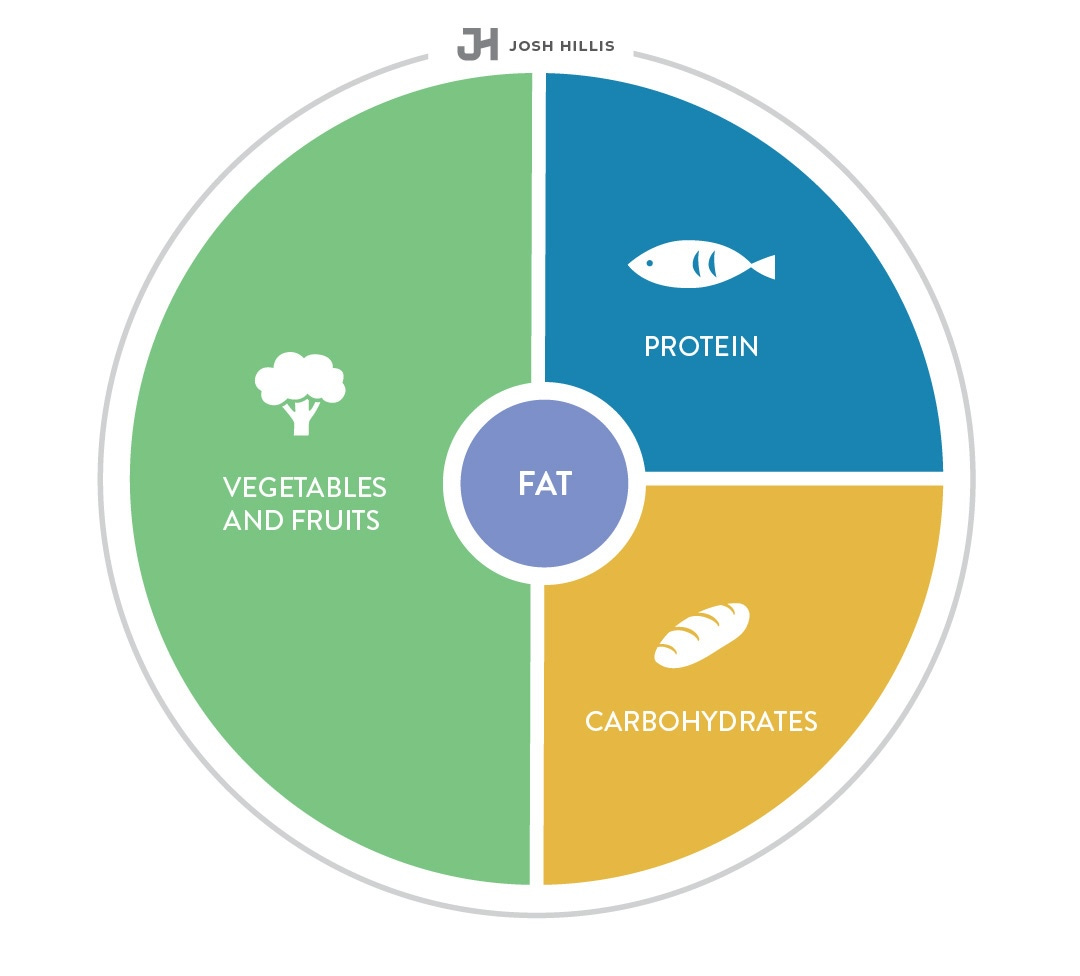
Above is the plate guideline from my book, Lean & Strong: Eating Skills, Psychology, and Workouts.
It’s based on:
- Harvard School of Public Health’s Healthy Eating Plate
- Health Canada’s Canada Food Guide
- United States Department of Agriculture’s MyPlate (2011-2026)
I just took what they all had in common. So, the Lean & Strong plate guideline, is actually a looser recommendation than any of the above. It’s a little bit more flexible. If you followed any of the above three guidelines, they’d fit into the L&S plate guideline, even though they have differences from each other.
You’ll notice the plate has about 25% protein by plate percentage (not by calories).
You can just eyeball the plate, and at about a quarter of your plate you’ll likely get about 30% of your protein by calories. That’s because fat is much more calorie dense than carbohydrates or protein. Even a tablespoon or so of protein would put you somewhere about 30% protein/30% fat/40% carbohydrates (total of the carb section and the carbs in the vegetable and fruit section).
The cool thing, though, is that you don’t need to count or track.
Again, if someone has a big muscle gain goal, they can overshoot. I’ve had people go up to 1/3 of their plate protein.
I’ve had many, many athletes use this guideline, and work from 1/3-1/4 of their plate protein, and have the protein all work out well for them.*
*If someone is an endurance athlete, especially training 2+ hours per day, they probably want to look at expanding their carbohydrate intake from this guideline, but that’s another post.
Also worth noting — you can use whatever plate balance you want:
- If you live in a different country, and your government has a different plate balance guideline, you can use that.
- If your registered dietitian or endocrinologist or cardiologist or someone gave you a specific plate balance, you can use that.
- If you experiment and find out that you feel more full with more carbs less fat, or more fat less carbs, or more protein, or whatever, feel free to adjust based on your own experience.
Meals That Don’t Have Vegetables
Sometimes it happens!
This may shock you, but not every meal I eat has a perfect 50% of the plate vegetables and fruit. My clients don’t hit it perfectly all of the time either <gasp!>
It’s actually totally fine.
Personally, if I’m having a meal that doesn’t have vegetables, I’ll keep the same protein and carbohydrate ratio — so about 50/50.
But the big takeaway here is this —
The plate guideline is a tool not a rule.
It’s there to make you feel more full. It’s not like a moral thing. It’s totally fine to have a meal that isn’t balanced.
If your meal isn’t as balanced, you might get hungry a little sooner. That’s it. That’s the only thing that happens. It’s not the end of the world.
Just Remember Most Stuff on Social Media about Protein is Nonsense
It’s mostly grifters just trying to stand out. They need to say something extreme or contrarian to get your attention.
It’s all nonsense.
Every step you’re taking in your nutrition journey should make eating simpler, not more complex.
If your plate doesn’t have vegetables, just balance your protein and carbs. Simple.
If you don’t get protein at a meal, you might get hungrier sooner. So plan snack. Or have the next meal sooner. Either way.
The more you zoom out, the easier things get. Think about your protein intake in terms of daily averages over weeks or months. No single day matters at all. Missing a meal is not a big deal. Just try to get balanced-ish meals most of the time. Simple.
Lastly, I’ve repeated this over and over again throughout this post, but I’m going to hit it one more time: Most of the results you want to get from protein, it’s strength training that does the heavy lifting (pun intended).
Just eat balanced-ish meals, most of the time. Simple.
Really, seriously, keep it that simple..
— Josh Hillis
Who is this Josh guy?
I’m a coach and author who helps busy professionals beat emotional eating.
My book, Lean & Strong, won the Benjamin Franklin Silver Medal Book Award for Psychology.
You might have seen me or my books in the Los Angeles Times, Experience Life! Magazine, Men’s Health, or The Denver Post.
I do one-on-one coaching. If you’re interested, comment “coaching,” and I’ll send you the details.

Leave a Reply